A blood pressure decision usually starts with a number that took about thirty seconds to get. You sit down, the cuff tightens, someone reads out 148/94 (or 126/82), and that figure quietly shapes the next few years of your treatment.
The catch is that blood pressure doesn’t sit still. It climbs when you rush for a lift, sags during a post-lunch slump, and drops to its lowest in the small hours when nobody is around to measure it. A single reading is one frame out of a very long film.
That’s why a doctor will sometimes ask for an ABPM test at home in Kolkata instead of leaning on clinic numbers alone. At Avante Health we arrange it at the patient’s own address. Below, we’ll go through what the test records, what it picks up that a one-off reading can’t, and how to tell whether it’s worth bringing up at your next appointment.
Why one reading can point you in the wrong direction
Blood pressure can shift 20 or 30 points throughout a regular day. Stress causes this, but so does pain, lack of sleep, a full bladder, strong chai, and talking while the blood pressure cuff is being used.
- Smoking can influence BP readings.
- Measurement technique is important.
- Cuff size and positioning can affect the result.
- Normal clinic readings may not reflect BP during daily activities or sleep.
That doesn’t make clinic readings useless, because they remain the first point of reference for most diagnoses. But when the numbers are borderline, or don’t reflect how a patient actually feels, one measurement isn’t enough to build a plan of action on. It’s a problem we see often in families who use home care services in Kolkata for an older parent: the log fills up with readings that don’t agree with each other, and nobody can say which one to trust.
What is ABPM, and what does it stand for?
ABPM stands for ambulatory blood pressure monitoring. “Ambulatory” only means you’re up and moving, living your normal day, instead of lying still on an examination couch.
- ABPM is a non-invasive test.
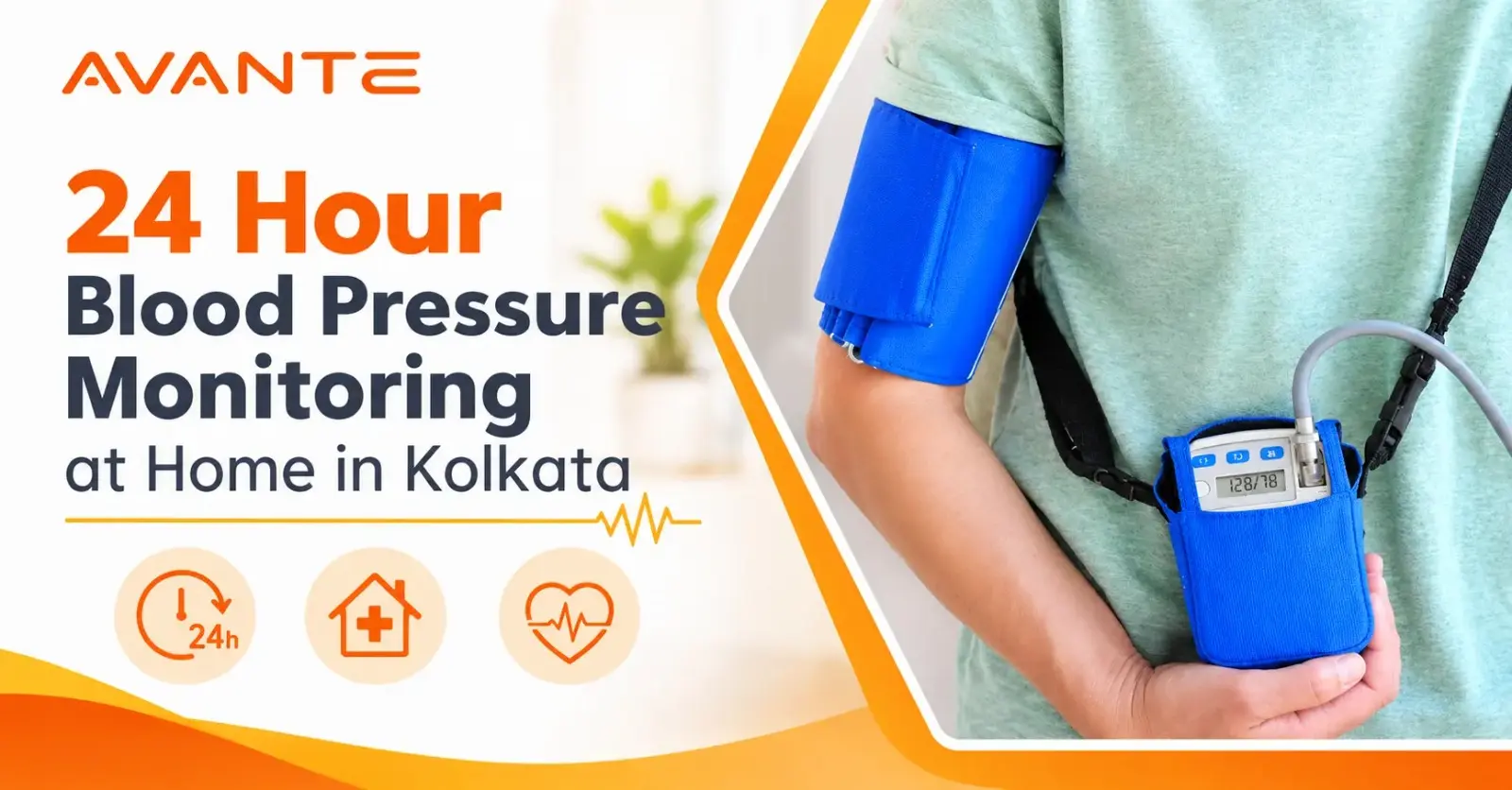
- It uses a portable monitor connected to an upper-arm cuff.
- It automatically records BP at regular intervals for approximately 24 hours.
- It captures readings during waking hours and sleep.
- It provides 24-hour, daytime and night-time averages.
How does ABPM function?
An ABPM monitor uses an upper-arm cuff connected to a small recording device, usually worn around the waist or carried in a pouch. It automatically records blood pressure at regular intervals over approximately 24 hours. According to the 2024 ESC guidelines, readings are typically taken every 15–30 minutes during the day and every 30–60 minutes at night.
Unlike a standard home BP monitor, ABPM records readings automatically, including during sleep. During the test, you can follow your normal routine while keeping your arm still when the cuff inflates. You may also need to maintain a diary of activities, medication timings, symptoms and sleep.
After 24 hours, the device is removed and the recorded data is downloaded to prepare a report for your doctor. With Avante Health’s ABPM service at home in Kolkata, the monitor can be fitted and collected at your residence, making the test more convenient for elderly patients and those with limited mobility.
What 24 hours of readings show that one number can’t
White-Coat Hypertension
Some people have higher blood pressure in a clinical setting but normal readings outside it. ABPM helps doctors determine whether the elevated clinic reading reflects their usual blood pressure. The results are considered alongside the patient’s medical history and cardiovascular risk before making treatment decisions.
Masked Hypertension
Masked hypertension occurs when clinic readings appear normal, but blood pressure is elevated during daily activities or sleep. ABPM can help identify this pattern, which might otherwise go unnoticed.
What Happens During Sleep
Blood pressure usually falls during sleep. A reduced fall is known as a non-dipping pattern, while an increase during sleep is called reverse dipping. ABPM records night-time readings to help doctors assess these patterns. However, an abnormal dipping pattern is not a diagnosis on its own and requires clinical evaluation.
The Morning Surge
Blood pressure often rises around the time a person wakes up. ABPM helps doctors assess this early-morning pattern and compare it with readings throughout the day. Any changes to medication timing or dosage should only be made by the treating doctor.
Swings During the Day
Two people may have similar average blood pressure readings but different patterns. While one person’s readings remain relatively stable, another may experience frequent fluctuations. Doctors review individual readings, averages and activity diaries to determine whether these variations are clinically relevant.
Whether Your Treatment Is Working
For people taking blood pressure medication, ABPM helps doctors assess how well their treatment controls BP throughout the day and night. It may identify periods when readings remain high or become lower than expected. The findings can support a treatment review, but medication changes should only be made by the prescribing clinician.
Why a doctor recommends ABPM
Patients often ask us why a test is being advised when their pressure has already been checked. Usually the doctor wants a fuller picture before making a decision that may last decades.
Typical reasons include:
- Repeatedly high, borderline or inconsistent clinic readings.
- Differences between clinic and home readings.
- Suspected white-coat or masked hypertension.
- BP remaining above the desired range despite treatment.
- Episodes of dizziness, faintness or suspected low BP.
- Possible night-time hypertension.
- Diabetes, kidney disease or cardiovascular risk factors.
- Reviewing BP before or during treatment when clinically appropriate.
ABPM is not necessary for everyone with a high reading. The treating clinician decides whether the test is appropriate based on readings, symptoms, medical history and the clinical question.
What the numbers mean
Your doctor will interpret the ABPM report based on your overall health, medical history and symptoms. According to the 2024 European Society of Cardiology (ESC) guidelines, ambulatory blood pressure levels are considered in the hypertension range at or above the following averages:
| Measurement | 2024 ESC Hypertension Threshold |
|---|---|
| 24-hour average | >130/80 mmHg |
| Daytime average | >135/85 mmHg |
| Night-time average | >120/70 mmHg |
These are guideline-specific reference thresholds, not individual treatment targets. Your doctor will consider your age, medical history, symptoms and medications when interpreting the results. One unusually high reading does not establish a diagnosis; the overall averages and blood pressure patterns are also important.
What to expect from an ABPM test at home in Kolkata
The home-based ABPM process is designed to make monitoring more convenient while recording blood pressure during your usual daily routine.
- Appointment and Preparation: The service team confirms the visit and explains what to expect during the test.
- Cuff Fitting: A trained professional measures your arm, selects the appropriate cuff size and connects it to the portable monitor.
- Device Instructions: You or your caregiver receive instructions on using the monitor and recording activities, symptoms, medication timings and sleep.
- Monitoring Period: You can generally continue your normal routine while the device automatically records blood pressure at regular intervals. Keep your arm relaxed and still when the cuff inflates.
- Device Collection and Report: After approximately 24 hours, the device is removed and the recorded data is downloaded to prepare a report for your treating physician.
For more details, contact Avante Health to arrange an ABPM test at home in Kolkata.
Where the 24hr ECG Holter monitoring service at home in Kolkata fits in
People often ask whether ABPM and Holter monitoring are the same test. They aren’t, although they get mentioned together because both run for a day and both can be done at home.
ABPM tracks your blood pressure. A Holter monitor tracks your heart’s electrical activity: a few small patches on the chest connect to a compact recorder that logs an ECG continuously, usually for 24 to 48 hours. It suits symptoms that come and go, like palpitations, skipped beats, short dizzy spells, unexplained breathlessness or fainting. A normal ECG in a clinic can easily miss a rhythm problem that shows up only once or twice a day. A longer recording has a far better chance of catching it.
Sometimes a doctor wants both. Take someone with long-standing hypertension who has started noticing palpitations: it matters whether the pressure and the rhythm are each behaving. Our 24hr ECG Holter monitoring service at home in Kolkata covers the second half, and the two tests can be planned together if your doctor asks.
Can an ECG be done at home?
Yes. A standard resting ECG uses a portable machine small enough to carry into a home. Electrodes go on the chest, wrists and ankles, and the machine records the heart’s electrical activity.
How long does an ECG take at home?
The recording itself takes a few minutes. Add setup, a short explanation and a moment to settle, and the whole visit is usually done in well under half an hour. A Holter is different, since the monitor stays on for a day or two, but fitting it is quick.
Can bedridden patients have an ECG at home?
They can, and for many families that’s the main reason to choose a home service. The test is done in bed, with no ambulance, no wheelchair and no waiting in a crowded corridor. Resting ECGs and Holter recordings can both usually be arranged for someone who can’t leave the house.
Can an ECG be done without a doctor’s consultation?
The test itself can be done without one, and plenty of people book an ECG as part of a routine check. What matters is who reads it. An ECG trace isn’t something to interpret on your own, so the report should go to a qualified doctor, especially if you’ve had chest pain, breathlessness or palpitations. If symptoms are sudden or severe, skip the home test and go to an emergency department.
How to measure blood pressure at home
Many people start with a home machine, which is a reasonable first step if the habits are right.
- Skip caffeine, smoking and exercise for 30 minutes beforehand, and use the toilet first.
- Sit with your back supported and feet flat on the floor. Legs uncrossed.
- Rest the bare arm on a table so the cuff sits at heart level.
- Stay quiet and still for five minutes.
- Take two readings a minute apart, once in the morning and once in the evening, and write them down.
- Keep this up for about a week before showing the log to your doctor.
Use a validated upper-arm monitor. Wrist and finger devices tend to be less dependable. Home readings are useful and fix some of the clinic problem, but they still capture only a few moments and can’t measure sleep. When something doesn’t add up, that’s usually the point where a doctor moves from home readings to ABPM.
Where to get a blood pressure check in Kolkata
If you don’t have a blood pressure monitor at home or would prefer professional assistance, you can get your blood pressure checked at a pharmacy, clinic, hospital outpatient department, or through a home visit.
For older adults, people with limited mobility, patients recovering from surgery, or anyone who finds frequent travel difficult, getting a blood pressure check at home in Kolkata can be a convenient option. A trained professional visits the patient, takes the reading using appropriate equipment, and records the result so it can be shared with the treating doctor.
Avante Health provides blood pressure check at home services in Kolkata for individuals who need convenient monitoring without travelling to a healthcare facility. While a single reading offers a snapshot of blood pressure at that moment, regular monitoring over several days can help identify patterns. Depending on the patient’s condition, a doctor may recommend maintaining a home BP log or undergoing 24-hour ambulatory blood pressure monitoring (ABPM).
Where home nursing fits
Some families first meet us through home nursing rather than diagnostics, so a quick word on how the two connect.
Home nursing care means a trained nurse provides medical support at the patient’s home. That can include injections or IV medicines as prescribed, drips, wound dressing, checking vitals such as blood pressure, pulse and oxygen, and help with recovery after surgery or illness. Being in a familiar room with family nearby makes recovery easier for many patients.
Blood pressure checks are a natural part of that. A nurse can track readings across a week, flag a worrying trend early and tell the doctor what they saw. A 24-hour ABPM or Holter adds more detail when it’s needed. Injections, IV medicines and infusions should be given only on a doctor’s prescription.
What affects the cost
Families naturally want to know what an ABPM test at home in Kolkata will cost before committing. We’d rather not print a figure in a blog, because prices change and a number here may not match your situation.
Several things move the price: whether it’s ABPM, Holter or both; whether the recording runs 24 or 48 hours; how far the visit is; the time of day; and whether a doctor’s review of the report is included. The quickest way to get a real figure is to call us. We’ll tell you what’s included before anything is booked.
Questions to ask any home monitoring service
Whichever one you select, ask who will be coming to visit and what their qualifications are, which equipment they use and whether the size of the cuff is going to match the arm, how and when the report comes and whether it captures the daily trend or just an average, who analyzes the data, what is done in case there is a failure during the process, and whether all costs are disclosed upfront. A good one does not balk at answering.
A moment versus a whole day
A single blood pressure reading is a fair place to start, but only a start. It can’t show what your pressure does at night, whether it jumps in the morning, whether your medicine lasts through the day, or whether the clinic number is quietly overstating or hiding the real picture.
If your doctor has suggested ambulatory monitoring, or your readings keep disagreeing with each other, a 24-hour record is worth considering. To talk through an ABPM test at home in Kolkata, a Holter study, or a blood pressure check at your doorstep, get in touch with Avante Health. We’ll explain the process, answer your questions and arrange it around your schedule.
Frequently Asked Questions
1. What is an ABPM test?
ABPM stands for ambulatory blood pressure monitoring. A portable device connected to an upper-arm cuff automatically records blood pressure at regular intervals over approximately 24 hours, including during sleep.
2. Is a 24-hour ABPM test painful?
The test is non-invasive. The cuff tightens during each reading and may cause temporary pressure or mild discomfort, particularly at night, but it is generally manageable.
3. Can I undergo an ABPM test at home in Kolkata?
Yes. Avante Health offers home-based ABPM monitoring in Kolkata. A trained professional fits the monitor and explains how to manage the recording period. Contact Avante Health to confirm availability for your location and preferred time.
4. Can I continue my normal activities while wearing the monitor?
Usually, you can continue your normal routine while following the instructions given by the fitting professional. Keep your arm relaxed and still during cuff inflation, and follow device-specific advice about bathing and strenuous activity.
5. What is the difference between ABPM and a home BP monitor?
A home BP monitor is used to take separate readings at selected times. ABPM automatically records blood pressure at regular intervals over approximately 24 hours, including during sleep.
6. What is the difference between ABPM and a Holter monitor?
ABPM measures blood pressure at regular intervals, while a Holter monitor continuously records the heart’s electrical activity to help investigate suspected heart rhythm abnormalities. They are two different tests.
7. How many readings should an ABPM report contain?
The required number depends on the guideline and monitoring protocol. The 2024 ESC guideline describes at least 70% usable readings, typically 27 or more over 24 hours, as a general validity standard. A clinician should assess the quality of the recording.
8. Who interprets the ABPM report?
The report should be reviewed by the treating physician, cardiologist or another appropriately qualified clinician. The findings are considered alongside symptoms, medical history and medication.
9. Should I change my blood pressure medicine based on an ABPM result?
No. Do not stop, start or change your medication or dosage timing independently. Discuss the report with your prescribing doctor, who will decide whether any changes are needed.
10. How do I book an ABPM test with Avante Health?
Call or WhatsApp Avante Health at +91 8100 6363 73, or visit the ABPM test at home service page to enquire about a home appointment in Kolkata.