India had just 2.20 registered nurses per 1,000 people as of March 2025, according to a written reply the Ministry of Health and Family Welfare gave in the Lok Sabha – still short of the World Health Organization’s recommended ratio of 3 per 1,000. At the same time, a 2025 government report on India’s ageing population projects the 60-plus population will more than double from 100 million in 2011 to around 230 million by 2036 -roughly 15% of the country. Put those two numbers together and the gap is obvious: more families than ever need skilled care for elderly or recovering relative and hospitals alone can’t absorb that demand. That’s why searches for dependable home nursing services in Kolkata have been climbing steadily, especially among people juggling full-time jobs with caregiving.
If you’re weighing this option for the first time, the uncertainty is understandable -you’re trying to judge unfamiliar services, unfamiliar staff and a fair price, often while already stretched thin. In this blog, you’ll discover exactly what home nursing care includes, how it differs from a home attendant’s role and how to choose a provider confidently -without getting lost in vague brochure language.
What Is Home Nursing Care and How Does It Work?
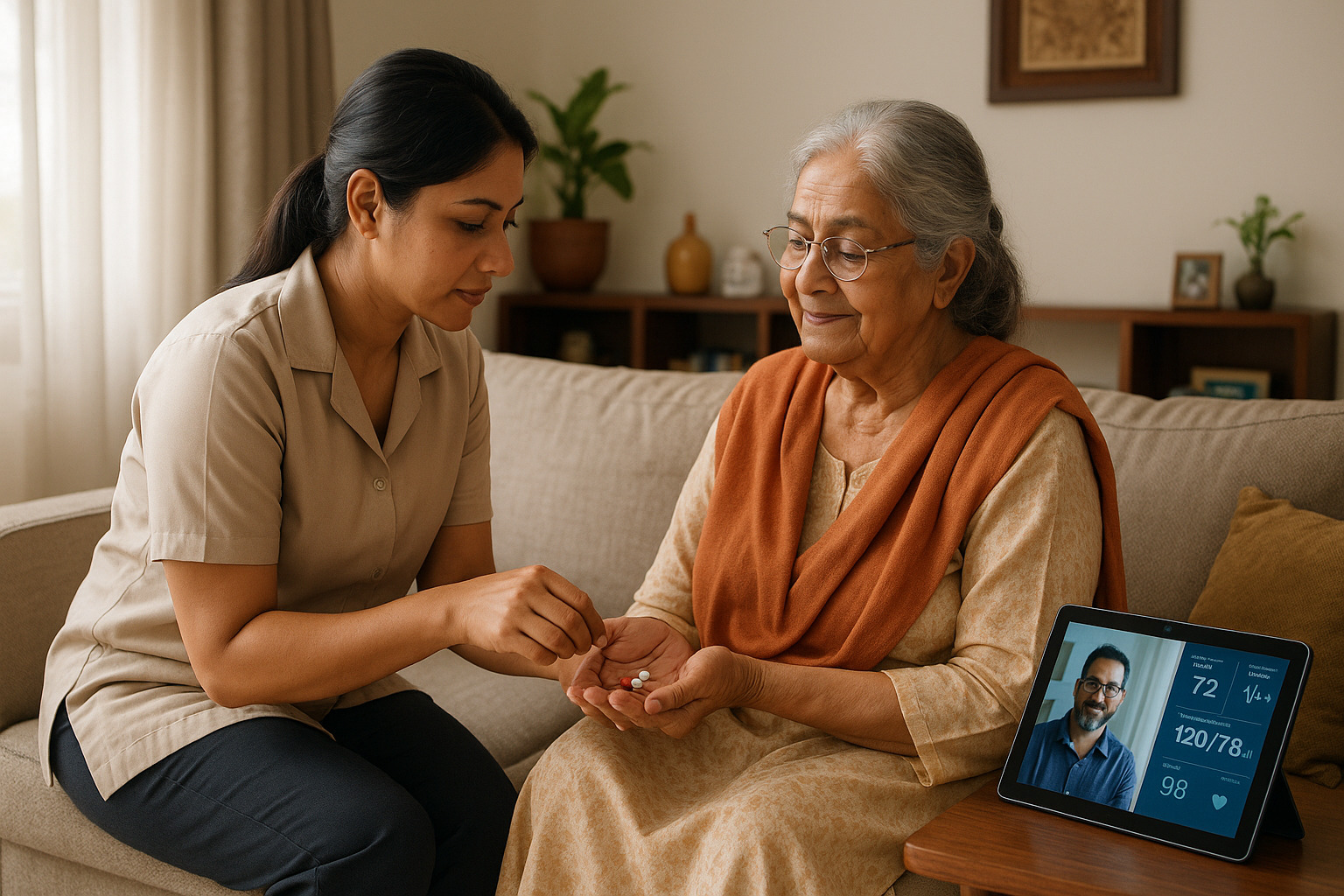
Home nursing care is skilled medical support delivered at home by a qualified, registered nurse -covering tasks like wound dressing, injections, catheter care, vital-sign monitoring and post-surgical recovery. Unlike general home help, it requires clinical training and is usually arranged around a doctor’s treatment plan.
A typical arrangement starts with a short assessment -either a phone consultation or a home visit -where the care needs, medical history and required frequency of visits are noted down. From there, a nurse is assigned either for scheduled visits (say, twice daily for dressing changes) or for round-the-clock, live-in support in more intensive cases like a bedridden patient recovering from a stroke or fracture.
This is different from non-clinical support. General home care service in Kolkata options often include companionship, mobility assistance and daily living support that don’t require a nursing license. Knowing which one your situation actually calls for is the first decision to get right -and it’s one many families get wrong simply because the terminology overlaps.
What Services Are Typically Included in Home Nursing Care?
Home nursing services typically include wound and dressing care, injections and IV administration, catheter and feeding-tube management, vital-sign monitoring, post-operative recovery support, medication management and coordination with the treating doctor. Providers often bundle these with attendant support and emergency response for complete home care.
| Service | What It Covers | Typical Patient |
| Skilled nursing visits | Wound dressing, injections, catheter/feeding-tube care, vitals monitoring | Post-surgery, chronic illness, bedridden patients |
| Live-in nursing | Round-the-clock clinical supervision and care | Stroke recovery, advanced age, palliative care |
| Home attendant services | Bathing, feeding, mobility support, companionship | Elderly individuals needing daily assistance |
| Emergency oxygen service at home | Rapid oxygen concentrator or cylinder deployment with monitoring | Breathlessness, COPD flare-ups, post-COVID recovery |
| Physiotherapy coordination | Mobility and rehabilitation exercises at home | Fracture, joint replacement, stroke recovery |
Most reputable providers in and around Kolkata bundle these services in tiers, so a family can start with basic attendant support and step up to full nursing care if the patient’s condition changes -without switching providers mid-recovery.
Home Nursing vs Home Attendant Services: What’s the Difference?
Home nursing involves a registered nurse performing clinical tasks such as injections, wound care and monitoring vital signs. Home attendant services in Kolkata cover non-medical daily support -bathing, feeding, mobility help and companionship -and don’t require a nursing qualification. Many patients need both, at different intensities.
| Factor | Home Nursing | Home Attendant |
| Who provides it | Registered/qualified nurse | Trained caregiver or attendant |
| Clinical tasks | Injections, dressing, catheter care, vitals | Not permitted -non-clinical only |
| Typical use case | Post-surgery, chronic disease, wound care | Daily living support, elderly companionship |
| Supervision | Often under a doctor’s care plan | Independent, routine-based support |
| Cost | Generally higher, reflects clinical skill | Generally lower, hourly or shift-based |
It’s worth asking any provider directly whether the person coming to your home is a registered nurse or an attendant and what tasks they’re trained and permitted to perform. Confusing the two is one of the most common -and most avoidable -mistakes families make when arranging care in a hurry.
When Do You Need Emergency Oxygen Service at Home?
An emergency oxygen service at home in Kolkata is needed when a patient shows breathlessness, low oxygen saturation (typically below 94%), or a diagnosed respiratory condition that requires supplemental oxygen between hospital visits. It should always be arranged under medical guidance, with trained staff to monitor flow rate and the patient’s response.
- Diagnosed COPD, severe asthma, or post-COVID lung recovery with fluctuating oxygen levels.
- A doctor has explicitly prescribed home oxygen therapy as part of a recovery or palliative care plan.
- Sudden breathlessness in an elderly or bedridden patient while awaiting transport to hospital.
- Oxygen saturation readings on a pulse oximeter consistently below the level your doctor has flagged as concerning.
This is not a service to arrange casually or without medical oversight -incorrect oxygen flow rates can be harmful, particularly for patients with certain chronic lung conditions. A responsible provider will ask for a prescription or recent medical report before deploying a concentrator or cylinder and will monitor the patient rather than simply dropping off equipment.
What Are the Benefits of Choosing Home Nursing Care Over a Hospital Stay?
For patients who are medically stable but still need clinical support, home nursing offers real advantages over an extended hospital admission -both for recovery and for the family managing it.
- One-on-one attention instead of a nurse dividing time across an entire ward.
- Lower exposure to hospital-acquired infections, which matters most for immunocompromised or elderly patients.
- Recovery in a familiar environment, which is associated with better outcomes for elderly and dementia patients in particular.
- Flexibility to scale care up or down -from a few hours a day to full-time live-in support -as the patient’s condition changes.
- Reduced burden on family caregivers, who often try to manage complex medical tasks themselves without training.
This is precisely the gap that eldercare researchers point to: as India’s population ages, the bulk of ongoing needs -mobility support, medication adherence, monitoring -aren’t hospital-centric, yet families have historically had to manage them without professional support. Structured home nursing is one practical answer to that gap.
How Do You Choose the Right Home Nursing Services in Kolkata?
Choose a home nursing provider by verifying that nurses are registered and background-checked, confirming the care plan is coordinated with your doctor, checking for 24/7 emergency support and asking exactly which clinical tasks each staff member is qualified to perform before service begins. Avante Health follows these considerations when arranging home nursing support, with care matched to the patient’s medical requirements and level of assistance needed.
- Confirm nursing qualifications and registration -ask directly rather than assuming from a brochure.
- Check whether the provider does background verification on staff who’ll be in your home.
- Ask how care plans are coordinated with the patient’s doctor and how often they’re reviewed.
- Clarify what happens in a medical emergency -response time, escalation process and hospital tie-ups if any.
- Get a clear breakdown of costs: per-visit, per-shift and live-in rates, plus what’s included versus billed separately.
- Ask for a trial shift or short-term booking before committing to a long-term arrangement.
It also helps to ask whether the parent healthcare facility behind the nursing service is registered under India’s Clinical Establishments (Registration and Regulation) Act, 2010, which sets minimum standards for facilities offering clinical services. It’s not the only mark of quality, but it’s a fair, verifiable starting point.
Making the Right Decision for Your Family
Finding the right home nursing services in Kolkata comes down to matching the level of care to what your situation actually needs -clinical nursing for medical tasks, attendant support for daily living and emergency oxygen response for respiratory conditions, all coordinated rather than arranged piecemeal. Verifying staff qualifications and asking direct questions before you book will save you from most of the problems families run into later. If you’re currently comparing providers, use the checklist above on your shortlist before making a decision and consider starting with a short trial period to see how the fit works for your family.
Frequently Asked Questions
1. Which is better for an elderly parent -a home nurse or a home attendant?
It depends on medical need. If your parent requires injections, wound care, or monitoring, a registered nurse is necessary. If the need is daily living support like bathing, feeding, or companionship, a home attendant is usually sufficient and more cost-effective.
2. How much do home nursing services cost in Kolkata?
Costs vary by service type – a scheduled nursing visit, a 12-hour shift, or full live-in care all carry different rates and pricing also depends on the complexity of the medical task involved. It’s best to get a direct quote based on your specific care plan.
3. What should I check before hiring a home attendant service?
Confirm the attendant has been background-verified, ask what training they’ve received and clarify exactly which tasks they can and cannot perform -attendants are not qualified for clinical procedures like injections or wound dressing.
4. Is emergency oxygen service at home safe without a doctor’s prescription?
No. Oxygen therapy should always be guided by a doctor’s assessment and prescription, since incorrect flow rates can be harmful for certain respiratory conditions. A responsible provider will ask for medical documentation before deploying equipment.
5. What are common mistakes families make when arranging home nursing care?
The most common mistakes are assuming an attendant can perform clinical tasks, not verifying nurse qualifications and not confirming how emergencies will be handled before care begins. Clarifying these upfront prevents most problems later.